How Do You Say How Many People Are in Your Family in Japanese

Learning a foreign linguistic communication isn't only about the linguistic communication itself, only also about its culture, community, and club. Family is the minimum unit of a social group, and information technology's of import to understand its characteristics as this is closely related to culture and customs.
When you learn how to explain your family in Japanese, it helps to expand your vocabulary and improve your communication skills in Japanese.
Compared to English, at that place are many more words to describe family members in Japanese. These words are co-ordinate to age and the style (formal and informal). For example, what is a Japanese father-in-police force called?
Permit's learn how to describe family in Japanese at JapanesePod101.com. Here'due south our list of the most useful Japanese words and family fellow member terms, as well as important data about family in Japan.
Table of Contents
- Family in Nippon – Cultural Perspective
- Bones Family Terms
- Terms of Relatives
- Family Terms as a Married Person
- Endearment Terms
- How to Describe Family unit and Ask Question nigh Family in Japanese
- Conclusion: How Japanesepod101 Can Help Y'all Learn More Japanese

one. Family unit in Nihon – Cultural Perspective

Before we move onto the actual family vocabulary, information technology's important that we go over family roles in Japanese culture, family values in Japanese society, and the importance of family in Japanese civilisation. This will give you a better idea of what to expect from Japanese families, and give more context to the Japanese family vocabulary and phrases yous're going to acquire!
1- Traditional and Mod Family in Japan
The traditional Japanese family is characterized by the 家 (Ie) or family unit organisation, which is literally translated as "household." Information technology refers to a dwelling house and family's lineage, which bestows importance of kinship and loyalty to their family.
Each fellow member of a family unit is expected to serve their family unit's interests (rather than the individual'due south) as a priority. The Japanese family is traditionally patriarchal and a household usually consists of grandparents, their son, his wife, and their children. The eldest son is expected to inherit the household assets, and he'due south responsible for taking care of his parents when they become erstwhile.
In the mod Japanese family unit, however, the influence of the traditional ie system isn't as strong equally information technology used to be. A 核家族 (kaku kazoku) or "nuclear family unit" is very common present, and consists of two parents and their children, typically centering on a married couple.
While a married couple is expected to live together with a husband's parents in the traditional Japanese family, grandparents don't alive with a kaku kazoku in a mod Japanese family unit (although they are visited often).
two- Becoming a Family in Japan (Wedlock)
In Japan, the 戸籍 (Koseki) or "family registration system" is mandatory to all households. It requires that the family unit records all changes in family composition and identity, such equally births, deaths, marriages, divorces, acknowledgements of paternity, adoptions, and disrupted adoptions.
It's required to register one person every bit the head of a household, and the rest of the members in a household must have the same surname equally that of the caput. Once a couple gets married, spouses are obligated to have the same surname, and registration of different surnames is non immune.
Due to the traditional system and the importance of kinship as custom, marriage isn't only a matter of the helpmate and groom, just too of their extended family. It's expected that extended families from both sides are going to have a "family relationship" once a couple gets married in Nihon. As such, relationships with i's in-laws get important.
3- Expressions of Family unit in Japan
At that place are various words to name family unit members in Japanese.
Japanese vocabulary words to depict family count age departure, and there are particular names related to age. This is considering age is regarded as 1 of the most of import attributions in the Japanese society, which is greatly influenced by the concept of Confucianism that states seniority is highly respected.
As relationships with in-laws are likewise culturally important, in that location are item names for them as well.
In add-on, there are variations of how to express family members, ranging from very casual to formal. Which ones to employ depend on the occasion.
Let's dive into the details in the following sections, and become you lot started with common family unit words in Japanese.
2. Basic Family Terms

Now, it'south time to learn some bones Japanese words for family members. These are the words you'll most ofttimes hear and utilise!
ane- Basic Family Vocabularies
The formal terms are usually used for official occasions and in written form, while the informal terms are commonly used in casual situations (orally) also as when calling a family fellow member.
| English | Formal | Informal |
|---|---|---|
| I / me | 私(わたし | – |
| watashi | ||
| father | 父(ちち | お父さん |
| chic | o-tō-san | |
| mother | 母(はは) | お母さん |
| haha | o-kā-san | |
| older sis | 姉(あね) | お姉さん / お姉ちゃん |
| one | o-nee-san / o-nee-chan | |
| younger sister | 妹(いもうと) | – |
| imōto | ||
| older brother | 兄(あに) | お兄さん / お兄ちゃん |
| ani | o-nii-san / o-nii-chan | |
| younger brother | 弟(おとうと) | – |
| otōto | ||
| grandfather | 祖父(そふ) | おじいさん / おじいちゃん |
| sofu | o-jii-san / o-jii-chan | |
| grandmother | 祖母(そぼ) | おばあさん / おばあちゃん |
| sobo | o-bā-san / o-bā-chan | |
| great grandfather | 曽祖父 (そうそふ) | ひいおじいさん/ ひいおじいちゃん |
| sōsofu | hii-o-jii-san / hii-o-jii-chan | |
| great grandmother | 曽祖母(そうそぼ) | ひいおばあさん/ ひいおばあちゃん |
| sobo | hii-o-bā-san / hii-o-bā-chan | |
| grandchild(ren) | 孫 (まご) | ー |
| mago | ||
| slap-up grandchild(ren) | ひ孫(ひまご) | ー |
| himago |
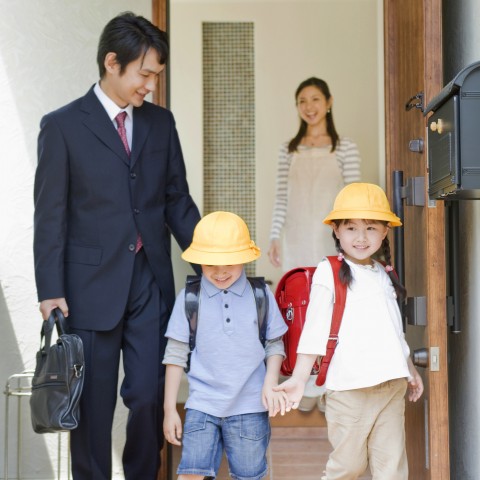
Average modern Japanese families usually have i or ii children.
two- More Vocabulary
- 家族 かぞく (Kazoku) : family
- 両親 りょうしん (Ryōshin) : parents (father & mother)
- 親 おや (Oya) : parent(s)
- 子供 こども (Kodomo) : child(ren)
- 兄弟 きょうだい (Kyōdai) : brothers
- 姉妹しまい (Shimai) : sisters
3- Examples
Here are some examples of Japanese phrases for family unit, so y'all have a better idea how to apply the vocabulary above.
- 私の家族は、お母さん、お父さん、私、弟の4人家族です。
Watashi no kazoku wa, o-kā-san, o-tō-san, watashi, otōto no yo-nin kazoku desu.
My family has four members: mother, father, me, and my younger brother. - 私は姉と妹がいる3姉妹です。
Watashi wa ane to imōto ga iru san-shimai desu.
I have an older sister and a younger sister, and we are three sisters. - 私は兄と姉がいます。
Watashi wa ani to ane ga imasu.
I have an older blood brother and an older sister. - 私は祖父と祖母が大好きです。
Watashi wa sofu to sobo ga daisuki desu.
I like my grandfather and grandmother very much.
To listen to the pronunciation of basic family unit terms, please visit Must-Know Terms for Family unit Members on our website.
Also, if yous would like to know more than almost Japanese numbers, please visit our Japanese Numbers article.
The bail between a mother and a daughter is frequently very potent.
3. Terms of Relatives
1- Vocabulary for Relatives
- 親戚 しんせき (Shinseki) : relatives
- 叔父 おじ (Oji) : uncle
- 叔母 おば (Oba) : aunt
- 甥 おい (Oi) : nephew
- 姪 めい (Mei) : niece
- いとこ (Itoko) : cousin
2- Examples
- 私の親戚は全員東京に住んでいます。
Watashi no shinseki wa zen'in Tōkyō ni sunde imasu.
All my relatives live in Tokyo. - 私は5人いとこがいます。
Watashi wa go-nin itoko ga imasu.
I take 5 cousins. - 私の叔父と叔母は教師です。
Watashi no oji to oba wa kyōshi desu.
My uncle and my aunt are teachers. - 私の姪は5歳で、甥は2歳です。
Watashi no mei wa go-sai de, oi wa ni-sai desu.
My niece is five years onetime and my nephew is ii years one-time.
4. Family Terms as a Married Person
ane- Vocabulary to Know equally a Married Person
- 結婚 けっこん (Kekkon) : marriage
- 既婚 きこん (Kikon) : married
- 未婚 みこん (Mikon) : unmarried
- 離婚 りこん (Rikon) : divorce
- 夫 おっと (Otto) : husband
- 妻 つま (Tsuma) : wife
- 息子 むすこ (Musuko) : son
- 娘 むすめ (Musume) : girl
- 義理の ぎりの (Giri no) : in-police
In order to limited "XXX in-police," add 義理の (Giri no) in front of XXX (the family member).
For example:
- 義理の両親 (Giri no ryōshin) : parents-in-law
- 義理の父 (Giri no chichi) : father-in-law
- 義理の母 (Giri no haha) : mother-in-law
- 義理の兄 (Giri no ani) : older brother-in-law
- 義理の弟 (Giri no otōto) : younger blood brother-in-law
- 義理の姉 (Giri no ane) : older sister-in-law
- 義理の妹 (Giri no imōto) : younger sis-in-law
two- Examples
- 私は夫と娘が1人います。
Watashi wa otto to musume ga hitori imasu.
I accept a husband and one daughter. - 私の義理の父と母は大阪に住んでいます。
Watashi no giri no chichi to haha wa Ōsaka ni sunde imasu.
My father and mother in-police live in Osaka. - 私は既婚者で子供が2人います。
Watashi wa kikonsha de kodomo ga futari imasu.
I am married and I accept two children. - 私の義理の両親は、私の息子におもちゃを買いました。
Watashi no giri no ryōshin wa, watashi no musuko ni omocha o kaimashita.
My parents-in-constabulary bought a toy for my son.
5. Endearment Terms

In improver to the formal and informal terms for family unit, there are also more than coincidental vocabulary words that you can telephone call family unit members. It may vary from household to household, or on what kind of relationships at that place are between family members, simply here are some examples. Only note that these are typically used in Japanese family relationships that are close.
1- Father
- パパ (Papa) : papa
Like in English, "papa" is a mutual name to telephone call a male parent in Japan, especially when children are very small. However, virtually Japanese people don't employ papa as they grow up.
- 父ちゃん (Tō-chan) : dad
This term includes a nuance of cute and comical amore.
- おやじ (Oyaji) : dad
This term is unremarkably used by sons who are mail-boyish age. When they become adults, they oft feel embarrassed to phone call their father papa or o-tō-san. This term also indicates a nuance of shut affection.
2- Mother
- ママ (Mama) : mama
Merely similar papa, mama is used particularly when children are still small.
- 母ちゃん (Kā-chan) : mom
This is the version of tō-chan used for mothers.
- お袋 (Ofukuro) : mom
This is the mother version of oyaji.
three- Granddaddy
- じじ (Jiji) : grandad
Grandchildren and their parents usually call a gramps by this term when the grandchildren are nevertheless small. It indicates a nuance of cute affection.
- じーじ (Jīji) : grandpa
This is very similar to jiji, simply the first ji is pronounced longer.
4- Grandmother
- ばば (Baba) : grandma
This is the grandmother version of jiji.
- ばーば (Bāba) : grandma
This is the grandmother version of jīji.
Grandparents often accept endearing nicknames when they have grandchildren.
half-dozen. How to Describe Family and Inquire Question almost Family unit in Japanese
Most of the time, at that place's no trouble with talking nearly family and relatives. When information technology comes to marital condition and children, nevertheless, it can be a delicate matter. It can sometimes be inappropriate to ask someone about his/her marital status or if they have children, unless he/she is open and willing to talk. This is specially truthful for a woman in her 30s.
Hither are some case questions and answers related to family.
Q:
何人家族ですか。
Nan-nin kazoku desu ka.
How many family members do you lot take?
A:
お父さん、お母さん、お姉ちゃん、私の4人家族です。
O-tō-san, o-kā-san, o-nee-chan, watashi no yo-nin kazoku desu.
I accept 4 family members: father, mother, older sister, and me.
—–
Q:
兄弟はいますか。
Kyōdai wa imasu ka.
Do y'all accept brothers and sisters?
*When asking a question, kyōdai can also refer to sisters.
A:
私は姉と弟がいます。
Watashi wa ane to otōto ga imasu.
I have an older sister and a younger brother.
—–
Q:
結婚していますか。
Kekkon shite imasu ka.
Are you married?
A:
はい、妻と子供が2人います。
Hai, tsuma to kodomo ga futari imasu.
Aye, I have a married woman and 2 children.
—–
Q:
孫はいますか。
Mago wa imasu ka.
Do you take grandchildren?
A:
はい、私は孫が6人います。
Hai, watashi wa mago ga roku-nin imasu.
Yes, I have six grandchildren.
—–
Q:
ご両親はお元気ですか。
Go-ryōshin wa o-genki desu ka.
How are your parents?
*It's polite to put go in forepart of ryōshin when you talk virtually someone's parents.
A:
はい、私の父と母は元気です。
Hai, watashi no chic to haha wa genki desu.
Yes, my begetter and mother are doing well.
—–
For more than well-nigh cocky-introductions, please visit Introducing Yourself in Japanese on our website.
seven. Conclusion: How Japanesepod101 Tin Help You lot Learn More Japanese
I hope this article well-nigh family unit in Japanese civilisation is useful and that information technology helps to improve your Japanese advice skills.
If you would like to learn more than virtually the Japanese language, y'all'll discover more than useful content on JapanesePod101.com. We provide a variety of gratis lessons for yous to meliorate your Japanese language skills. For example, Must-Know Terms for Family Members is helpful if you lot desire to practice family terms in Japanese with audio.
We also have YouTube channel: JapanesePod101. It'south always fun to learn Japanese past watching videos and listening to actual Japanese pronunciation.
Earlier you go, permit us know in the comments if there are any family terms you still want to know! And to practice, write a short paragraph about your family in bones Japanese. We look forward to hearing from you!
Source: https://www.japanesepod101.com/blog/2019/12/06/japanese-family-words/

Post a Comment for "How Do You Say How Many People Are in Your Family in Japanese"